
The Battle of New Orleans: January 8, 1815
How an Unprepared City Survived Against the Odds
On the morning of January 8, 1815, New Orleans should not have survived.
The city was young, divided, poorly defended, and sitting at the mouth of one of the most valuable rivers in North America. If the British captured New Orleans, they would control the Mississippi River and effectively split the United States in two. The stakes were enormous — and the city was nowhere near ready.
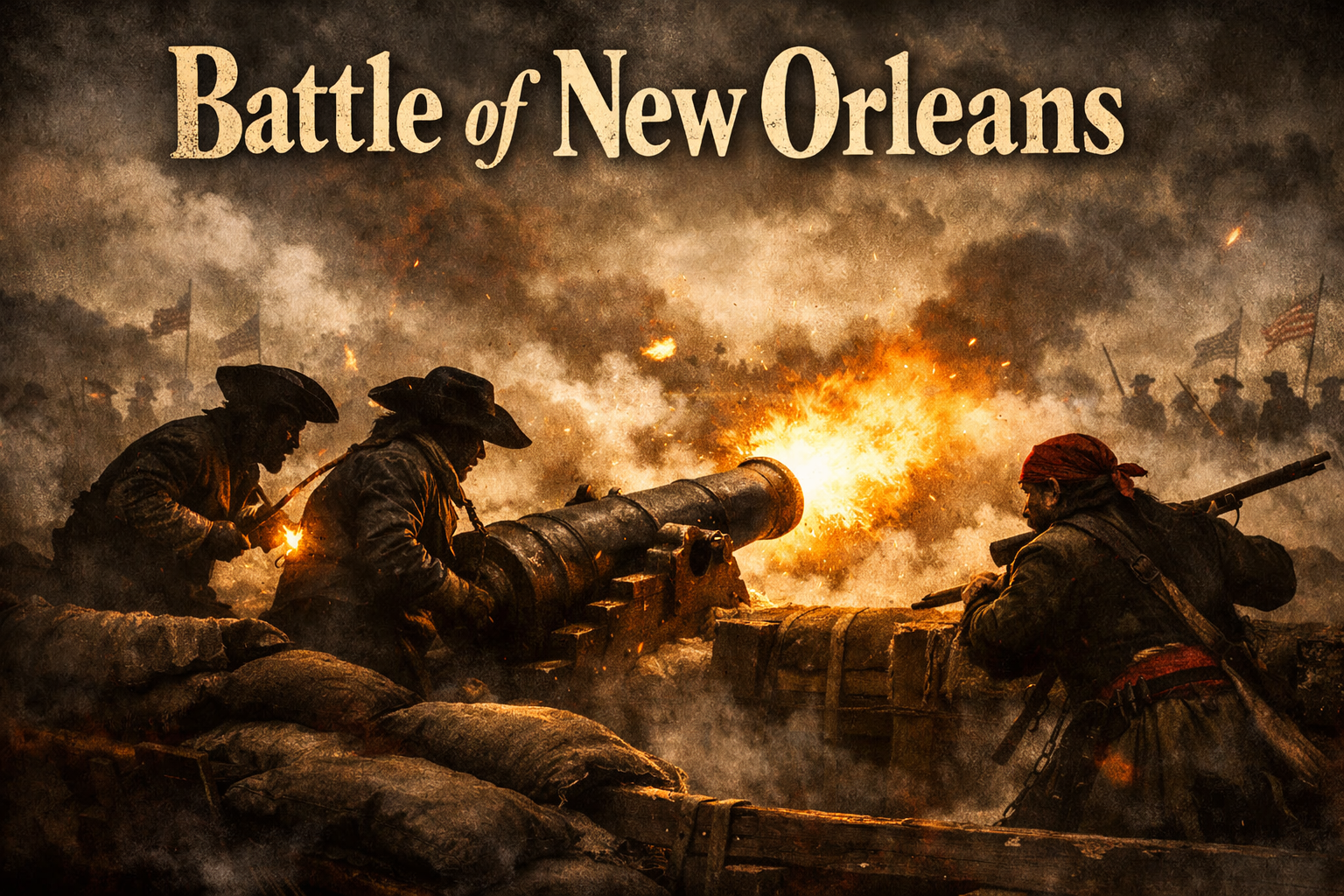
What followed was not a neat, heroic battlefield victory led by polished armies. It was a desperate stand by an improvised force: frontiersmen and free Black soldiers, Native American warriors, enslaved laborers, doctors turned artillerymen, sailors, smugglers, and pirates. The Battle of New Orleans wasn’t just a military engagement — it was a moment when an entire city was forced to fight for its survival.
A City Caught Off Guard
In late 1814, New Orleans was dangerously exposed. The War of 1812 had dragged on for years, draining resources and attention. The city had minimal fortifications, a tiny standing army, and no reliable way to stop a professional British invasion force.
General Andrew Jackson arrived in December 1814 and immediately recognized the problem: there were not enough men, not enough weapons, and not enough time.
Supplies were scarce. Gunpowder was limited. Cannons were outdated. Uniforms were nonexistent. Disease was rampant. Yellow fever outbreaks had already thinned the population, and mistrust ran deep among the city’s diverse residents — Americans, Creoles, French speakers, Spanish Isleños, enslaved Africans, free people of color, and recent immigrants all lived side by side, but not always together.
Jackson needed fighters. He needed laborers. He needed knowledge of the land. And he needed it immediately.
An Army Made From Everyone
The force that ultimately defended New Orleans was unlike any other American army at the time.
Regular U.S. Army troops were present, but they were vastly outnumbered. State militias arrived from Kentucky, Tennessee, and Louisiana — many poorly equipped, some without proper firearms. Choctaw warriors joined the fight, bringing critical scouting and combat experience in the swamps.
Free men of color volunteered and were organized into formal battalions, serving with discipline and distinction. Enslaved men were forced into labor roles, digging trenches, hauling artillery, and fortifying earthworks that would become the city’s lifeline.
Doctors, merchants, sailors, and laborers abandoned their professions to stand behind the ramparts. Flatboat men from the Mississippi, hardened by river life, manned artillery. Even Catholic priests and nuns assisted with care, logistics, and morale.
New Orleans didn’t field an army — it became one.
Why Jackson Needed the Pirates
Despite this surge of manpower, Jackson still faced a critical problem: artillery.
New Orleans lacked enough heavy cannons and trained gunners to defend the city. The British navy, by contrast, was the most powerful in the world. Without experienced artillery crews, Jackson’s defenses would collapse under naval fire.
This is where the city turned to a group it had spent years trying to suppress.
Jean Lafitte and the Baratarians were smugglers operating out of the Louisiana marshes. They knew the waterways, the tides, the hidden channels. More importantly, they had cannons — and men who knew how to use them.
Lafitte’s men were sailors, privateers, and artillery specialists. They had fought naval battles, loaded guns under fire, and operated heavy weapons with precision. When they joined Jackson’s defense, they didn’t just add numbers — they added expertise.
Pirates didn’t stand at the front lines waving flags. They manned batteries, trained soldiers, handled powder, and turned makeshift earthworks into deadly fortifications.
Without that knowledge, the American line may never have held.
The Battlefield: Mud, Smoke, and Chaos
The main defensive line was established along the Rodriguez Canal, just outside the city. It wasn’t a fortress — it was a hastily reinforced ditch backed by mud, cotton bales, timber, and desperation.
On the morning of January 8, thick fog covered the battlefield. When it lifted, British troops advanced in tight formations, expecting a quick victory over what they assumed was an inferior force.
They were wrong.
American artillery tore through the advancing ranks. Riflemen picked off officers. The defensive line held — and held brutally. Within hours, the British assault collapsed under devastating fire.
The Americans suffered remarkably few casualties. The British suffered thousands.
It was one of the most lopsided battles in U.S. history.
A Victory Built on Improvisation
What makes the Battle of New Orleans so remarkable isn’t just the outcome — it’s how unlikely it was.
There was no grand preparation. No long-planned strategy. No unified army waiting in place. The city survived because it adapted. Because it accepted help wherever it came from. Because it turned smugglers into soldiers, laborers into defenders, and a vulnerable port into an unbreakable line.
This was not a clean victory. It was messy, chaotic, and deeply human.
And its story doesn’t end on the battlefield.
Walking Where It All Happened
Much of this history isn’t found in textbooks or statues. It’s written into the streets, the river, and the forgotten corners of the French Quarter — places where decisions were made, alliances formed, and lines crossed.
The pirates didn’t just fight at Chalmette. They moved through New Orleans. They negotiated, recruited, supplied, and prepared within the city itself. The Battle of New Orleans was won long before January 8 — in back rooms, river landings, and shadowed alleys.
That’s where the story truly lives.
If you want to understand how an unprepared city survived one of the greatest invasions in American history — and why pirates played a role no one expected — the best way to learn isn’t from a plaque.
It’s by walking the ground, hearing the stories, and seeing New Orleans the way it was when everything was on the line.
☠️ Discover the pirate side of New Orleans history on a guided Pirate Walking Tour — where the battle begins long before the first cannon fires.