
New Orleans at Night: Why the French Quarter Feels Different After Dark
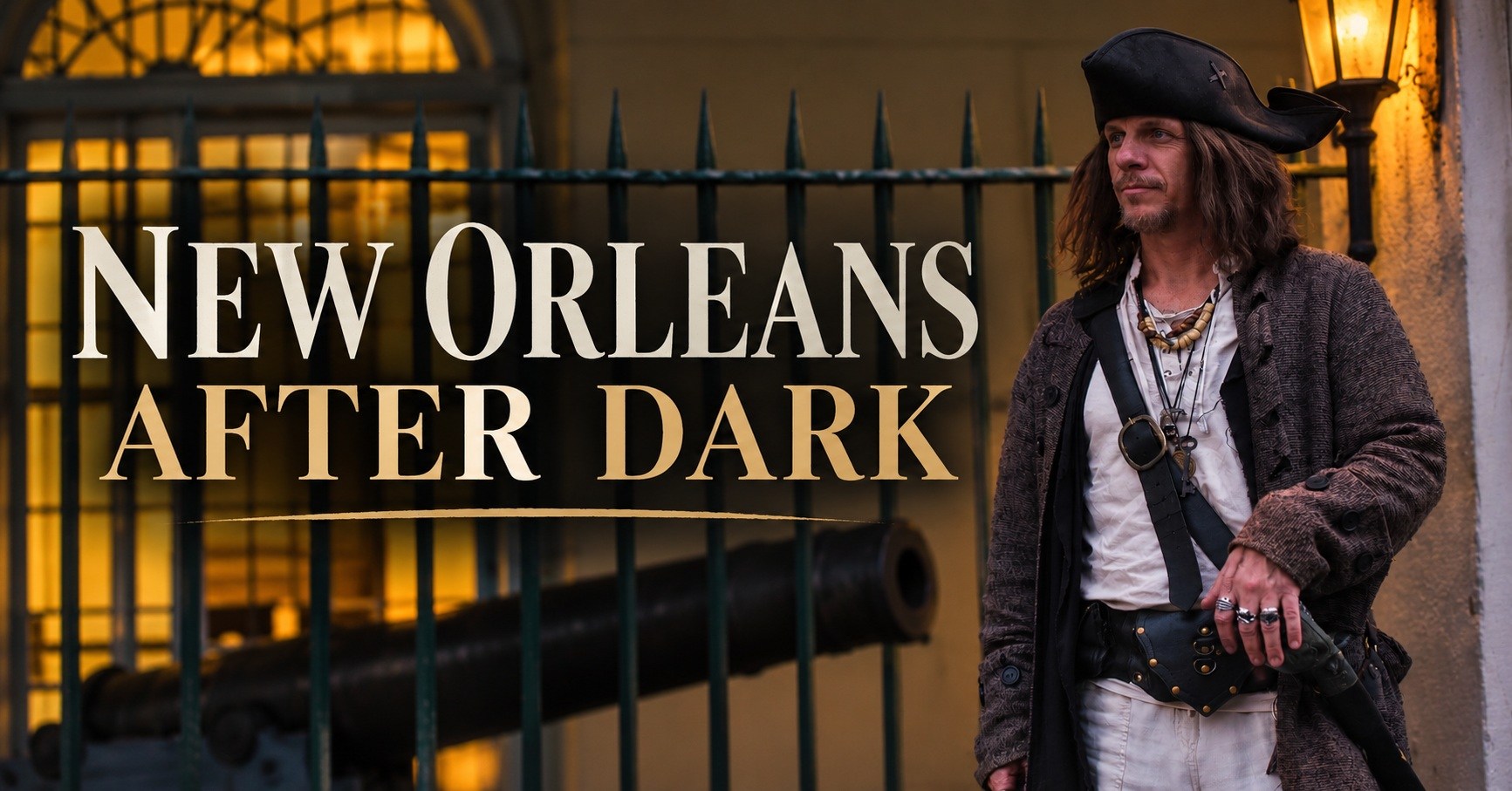
You don’t need to believe in ghosts to understand why New Orleans feels different after dark.
Spend an afternoon walking through the French Quarter and it can be bright, colorful and loud. Music spills from open doors. Tour groups move down the sidewalks. Balconies hang overhead. Courtyards appear unexpectedly behind iron gates.
Then the sun goes down.
The same streets seem narrower. The buildings feel taller. Gas-style lamps glow along old walls. Shadows stretch beneath balconies and galleries. Pirates Alley, just steps from Jackson Square, can suddenly feel a very long way from the modern city.
Maybe that’s why New Orleans and ghost stories have always gotten along so well.
But the French Quarter doesn’t need ghosts to be interesting after dark.
The real history is strange enough.
The French Quarter Was Built for Shadows
The French Quarter is New Orleans’ oldest neighborhood, dating to the city’s founding in 1718. Its distinctive architecture developed over generations of French, Spanish, Creole and American influence.
Walk around today and you’ll find buildings pressed close to the sidewalk, narrow streets, enclosed courtyards, shutters, passageways and iron balconies and galleries extending above pedestrians.
During the day, those details are beautiful.
At night, they completely change the character of the neighborhood.
A doorway that seemed ordinary at noon becomes a black opening in a brick wall. An iron gallery throws patterns across the sidewalk. A courtyard visible through an open gate seems to disappear into another world.
And before modern lighting, those shadows were considerably darker.
Imagine These Streets Before Electricity
For most of New Orleans history, nighttime really meant darkness.
Before the city had streetlights, illumination came from candles, fireplaces, lanterns and torches. In the 1790s, Spanish Governor Francisco Luis Hector de Carondelet ordered some of New Orleans’ first streetlights installed—simple oil lamps that offered considerably less illumination than we’re accustomed to today.
Gas lighting arrived during the 1800s, followed eventually by electric streetlights late in the century.
But picture the earlier French Quarter.
No neon signs.
No headlights.
No glowing cellphone screens.
No bright hotel entrances.
Just scattered lamps, candlelight escaping through windows and the occasional lantern moving through the street.
And you weren’t walking through a quiet little historic neighborhood.
You were walking through one of America’s busiest port cities.
Sailors, Soldiers, Smugglers and Strangers
The Mississippi River is easy to forget when you’re standing in the middle of Bourbon Street.
Historically, it was impossible to forget.
The river connected New Orleans to an enormous commercial world. Ships arrived carrying cargo and people from across the Gulf, Caribbean, Atlantic and beyond.
That meant the streets of New Orleans were filled with an extraordinary mixture of merchants, sailors, soldiers, laborers, immigrants, enslaved people, travelers—and smugglers.
Some of those smugglers were the men associated with Jean Lafitte and the Baratarians.
Lafitte’s network operated from Barataria south of New Orleans during the early 1800s, bringing illegally imported goods into a city hungry to buy them.
Those men didn’t look like the Hollywood pirates we imagine today.
They were businessmen, sailors, privateers, smugglers and criminals.
And they were part of the world moving through New Orleans.
So when you walk through the Quarter at night today, forget the ghosts for a moment.
Imagine who might have been coming around the corner two hundred years ago.
Pirates Alley Changes After Dark
There may be no better example than Pirates Alley.
During the day, it’s one of the most photographed little passages in New Orleans.
It’s tucked beside St. Louis Cathedral and the Cabildo, only steps from Jackson Square. The passage was historically known as Orleans Alley, and its connection to pirates has accumulated plenty of legend over the years.
At night, it becomes something else.
The crowds thin. The Cathedral rises above the alley. The lamps illuminate portions of the old buildings while leaving others in shadow.
Stand there for a minute without looking at your phone.
It’s surprisingly easy to mentally remove the modern city.
That’s one of our favorite things about the French Quarter.
History is still physically around you.
You aren’t looking at a photograph of an old neighborhood.
You’re standing inside one.
The Buildings Hide Half the Story
One of the secrets of the French Quarter is that much of it isn’t visible from the street.
Behind many buildings are courtyards enclosed by walls, neighboring structures and service buildings. Historically, these weren’t merely decorative spaces. Courtyards were working parts of homes and businesses—places for household chores, gardens, livestock, carriages and access to rear buildings.
From the sidewalk, you might only catch a glimpse through a doorway.
That’s part of what makes walking the Quarter at night so interesting.
There’s always the sense that something exists behind the façade.
A passage leads somewhere.
A staircase disappears into a courtyard.
A balcony hangs above a doorway.
A gate opens and, for a few seconds, you see an entire space you didn’t know existed.
Then it closes again.
No ghost required.
New Orleans Has Plenty of Ghost Stories. We Prefer the History.
We understand why people come to New Orleans looking for ghosts, vampires and things that go bump in the night.
October is a particularly good time for it.
But one of the things we love about New Orleans is that you don’t have to invent much to make the city’s past fascinating.
There really were pirates and smugglers.
There really were duels.
There were public executions, notorious criminals, taverns, brothels, political schemes and fortunes won and lost.
The French Quarter has seen wars, fires, epidemics, celebrations and more than three centuries of people behaving very much like people.
Sometimes badly.
If you’re interested in that side of the city, you might also enjoy our Dark Side of New Orleans History: Executions, Duels, Brothels & Debauchery article.
Because sometimes the truth is better than the ghost story.
One of the Best Times to Walk the French Quarter
October makes an especially good month to experience New Orleans after dark.
The days begin getting shorter. Halloween decorations appear throughout the neighborhood. Costumes become increasingly normal. And after the long New Orleans summer, walking around the Quarter becomes considerably more pleasant.
There’s plenty happening around town, which is why we also put together our Things to Do in New Orleans in October and Halloween in New Orleans guides.
But give yourself some time simply to wander.
Walk Royal Street.
Cross Jackson Square.
Step into Pirates Alley.
Look up at the balconies instead of down at your phone.
And when you find one of those quiet blocks illuminated by old-fashioned lamps, try imagining the same street 200 years ago.
That’s when the French Quarter starts getting interesting.
Want the Stories Behind the Streets?
At Pirates of the Quarter, that’s exactly what we do.
Our Pirate Guided Walking Tour explores the real history of Jean Lafitte, the Barataria smugglers, the Battle of New Orleans and the French Quarter they knew.
No treasure maps.
No parrots.
And we don’t need to invent ghosts.
The real New Orleans is wild enough.
Book the Pirate Guided Walking Tour