
Secret History of Jackson Square: What Most Visitors Never See
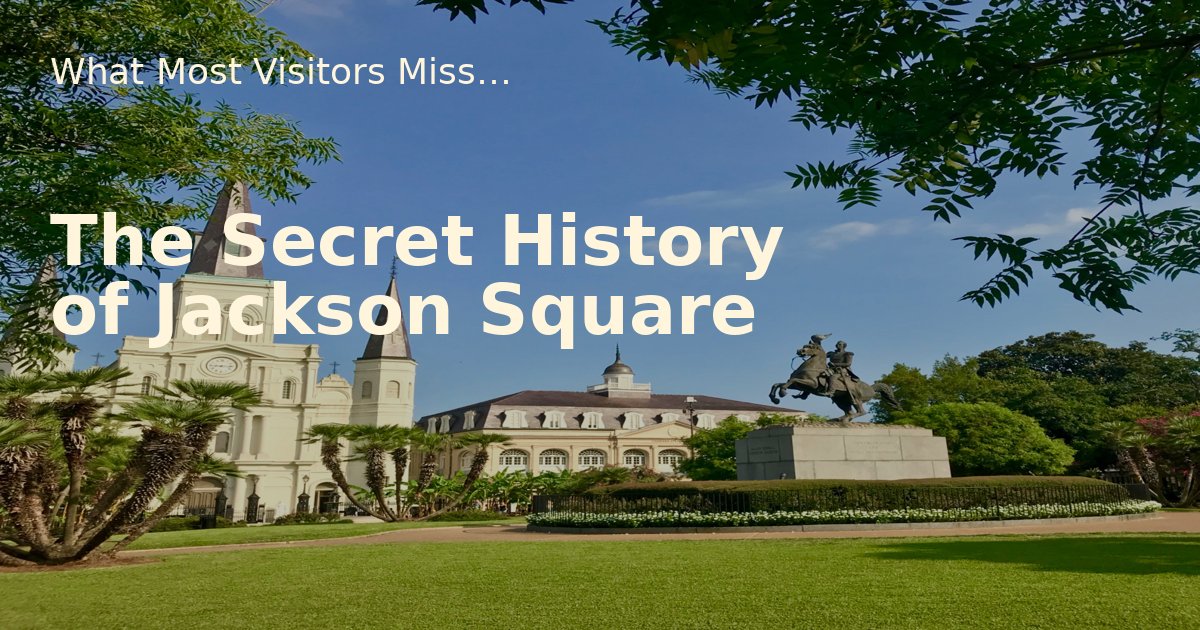
Most visitors to Jackson Square see exactly what they expect: street artists lining the iron fence, musicians filling the air with sound, and the towering presence of St. Louis Cathedral rising above it all.
But what most people miss is this:
Jackson Square isn’t just a beautiful landmark—it’s one of the most layered, contested, and quietly dangerous pieces of ground in early American history.
And if you know where to look, the past is still sitting just beneath your feet.
Before It Was Jackson Square
Long before it honored Andrew Jackson, this space was known as the Place d’Armes—a military parade ground at the heart of colonial New Orleans.
French soldiers drilled here. Spanish officials governed from its edges. Executions, punishments, and public displays of authority unfolded in full view of the city.
This wasn’t a park.
It was a stage for power.
Stand in the center today and it’s hard to imagine—but this ground once carried the tension of an empire trying to hold control over a volatile port city.
The Fires That Reshaped the Square
In 1788 and again in 1794, massive fires tore through New Orleans, destroying much of the original French colonial city surrounding the square.
What you see today—the architecture, the layout, the feel—is largely the result of Spanish rebuilding efforts.
That’s why the buildings around Jackson Square don’t look purely French. They aren’t.
They’re Spanish interpretations of a French city, rebuilt under pressure after catastrophe.
A Front Row Seat to the Louisiana Purchase
In 1803, the Jackson Square became the setting for one of the most important transfers in American history—the Louisiana Purchase.
The ceremony itself took place just steps away.
Three flags were raised and lowered in succession:
- Spain
- France
- The United States
In a matter of days, New Orleans—and everything tied to it—changed hands.
But power on paper doesn’t mean control in reality.
Where Law and Smuggling Collided
In the early 1800s, New Orleans was a city where official law and underground trade existed side by side.
Just beyond Jackson Square, along the river and into the bayous, smuggling networks thrived. Goods moved quietly. Deals were made in shadows.
And no name is tied to that world more than Jean Lafitte.
While Lafitte himself operated primarily out of Barataria, the influence of his network reached directly into the city. Merchants, officials, and buyers all intersected in places like this—close to power, but never fully controlled by it.
Jackson Square wasn’t isolated from that world.
It sat right next to it.
The Cathedral and the Unseen
The presence of St. Louis Cathedral adds another layer entirely.
During the lead-up to the Battle of New Orleans, prayers were held here as the city prepared for what many believed would be its fall.
Religion, war, fear, and survival all converged in this single space.
And yet today, most people pass through without ever realizing how close the city came to being lost.
Pirates Alley: The Narrow Passage Most People Miss
Tucked along the side of the cathedral is Pirates Alley—a narrow passageway that most visitors walk past without a second glance.
But historically, spaces like this mattered.
They were where conversations happened out of sight. Where deals were made quietly. Where information—and influence—moved without notice.
In a city built on trade, secrecy wasn’t an exception.
It was part of the system.
What Most Visitors Never Realize
Jackson Square looks calm today. Controlled. Designed for visitors.
But beneath that surface is a place shaped by:
- Military control
- Colonial conflict
- Fire and rebuilding
- Smuggling networks
- War and uncertainty
This isn’t just a stop on a sightseeing list.
It’s one of the most important intersections of power, commerce, and survival in early New Orleans.
Experience the Square the Way It Was Meant to Be Understood
Most people walk through Jackson Square and leave with photos.
A few leave understanding what actually happened here.
Our pirate walking tour moves through Jackson Square and into the surrounding streets, connecting the real history of men like Jean Lafitte to the places where their influence was felt.
No exaggeration.
Just the story as it actually unfolded—on the same ground you’re standing on.
FAQ
What is Jackson Square known for?
Jackson Square is known for its historic role in colonial New Orleans, its proximity to St. Louis Cathedral, and its connection to major events like the Louisiana Purchase.
Was Jackson Square important during the Battle of New Orleans?
Yes. The nearby St. Louis Cathedral played a key role during the lead-up to the battle, with prayers held as the city prepared for attack.
Is Jackson Square connected to pirate history?
While not a pirate base itself, Jackson Square sits at the center of a city deeply influenced by smuggling networks tied to Jean Lafitte and the Baratarians.